Monday, 20 January 2020

Does your head belong to you ?

Does your head belong to you ? Really ???
In a rather educated society I feel quite perplexed to even initiate a question like this.
I am a regular commuter through the busy and pot hole ridden metro of Bengaluru. The bumper to bumper slow moving traffic makes the writer in me , notice many an interesting occurrence some savoury and some mind boggling.  Two wheelers swishing  between motor vehicles at such unapproved speeds is one such ;
so much so either ur side view mirror is broken or a part of the paint is scraped off or you have just missed tipping him off.  The fingers have to be always crossed.
Cops on side walks are serving  challans  left , right and centre for all reasons mostly legit and some for sadistic pleasure. There is a strict road rule that helmets are compulsory for the rider and the  pillion.  But what I witness on a daily basis are that  most  two wheeler drivers are without helmets . Some do  but with  the belt under the chin as loosely strung as a ' hammock ' , of no use to God or Man. This is simply to beat the cop at his game.
My question then is , if the cop is getting a fine out of someone without a helmet , then why not from these frauds as well ? Next point is the quality of the helmet worn . It can be as inferior as a ' coconut shell ' or something that looks colourful and decent enough ; but not strong as to take an impact on the  hard , metalled road ! If the intent is to save lives let's ensure that only ISI marked ones are permitted and that they are well strapped on.
The main question to the citizen is --- Whose head is it anyway ? Are u not responsible for your life ? Do you think Cops and the  administration alone  blameworthy for the longevity of your life ? Are you not accountable for your family ? So many of you may be the only earning member with multiple obligations. Why are you on such a suicidal path ?
I almost get hysteric when I see a fatal two wheeler accident and on scrutiny discover that the victim was riding without a helmet and the question lingers ' may be ' he could have survived had he worn a helmet !

Wednesday, 25 December 2019

Reminiscing Christmas in the Forces

I decided to put up this couple pic this morning .There is ample reason for it. Christmas reminds me of the awesome times we had in the Army when each and everyone would join in for the merry making. The celebrations would start when I would start my baking . The bachelors  would come with their brandy and rum to drench the fruits, to such an extent that the fruits would be drunk !!  I was married into this awesome fraternity of the INDIAN ARMY at the young age of 21! From there started a long adventurous, fun filled journey. Most of my cherished dreams were fulfilled on this expedition called LIFE. Learnt what camaraderie meant , how to celebrate all festivals.  Pray in a Mandir , Mazhar , Gurdwara or Church . Experimented with different cultures and cuisine. To help everybody in need and to be proud of this great Country we belong to.
Made a lot of lasting friends. Lost so many forever on battle fields and insurgencies. We carry their memories with us forever with a prayer for their souls.

The result , our children are well adjusted in society and doing well despite the 14 schools my child attended !
I am amazed when I read that certain people feel hesitant to stand up for the National Anthem. I can't believe it. For me, listening to our National Anthem anytime ,anywhere , makes my heart swell with pride and my feet are restless to stand up.
Here I team up with my husband donning the OLIVE GREEN and me in an elegant MYSORE SILK. But my saree is nowhere comparable to the smart Army Combat camouflages!
JAI HIND


Sunday, 11 August 2019

My love affair with Indian handlooms

Welcome to my extensive world of the warp and weft of handlooms. The texture, the hues, the feel, the way the yarn is woven in such intricate detail to become a magical dream does not fail to fascinate me. I can indeed gaze and gaze and be mesmerized by the processes that go into the manufacture of a handloom fabric drape.
Maheshwari Brocade


Each motif or print and the methodology used to create folklore into the fabric is also enthralling. The end product is like reading an epic! The blocks are mostly made of teak and the designs are traced on to it like we do on paper. This design is then carved into the block which is dipped into the dye and pressed on to the cloth.
Block printing
Since it is a hand block print, you may notice that the prints may not all be equal. There may be some prints bright and some a little dull. All prints may not be uniform in size either. Many people mistake this as a flaw in the fabric but this is the quintessential essence of a typical handloom, as it is hand-printed.

The looms of India are rooted in our ancient past which is unfortunately not very well chronicled. When I visited places like Lothal, Paithan and Patan, I learnt that the Indian textiles were already on the looms in Mohenjodaro and Harappa. Like the Indian spices, these weaves were in great demand during those days itself in China and Egypt. Hence, they were being exported from time immemorial. 
The dyes used for printing are made from eco friendly material like Indigo, flowers, roots, rice flour, turmeric, saffron, barks,leaves, gum etc. This in itself is a labour intensive process which involves drying, powdering and finally mixing with water or other liquids to get the right consistency. Other than blocks, matchsticks, twigs, fingers are used for painting. 
In case you love re-visiting history, you will come across varied sculptures and designs on temple walls, step wells and palaces. The length and breadth of India is a stock pile of stunning examples of art and architecture. Most of the prints are copied from such ancient art forms onto yards of silk and cotton. A single saree may tell you a part of a story on history or a part from our epics and the everyday life of a bygone era. Remember, when you are wearing a heritage six yard, you are also wearing a part of a story in history!
India being an age old civilization, she can boast of more than a hundred different kinds of handloom. It is one of the biggest cottage industries.
Kerala Kasavu Saree
Unfortunately, many such production units are at a nadir. The reasons are that most people prefer going in for drapes manufactured on the power loom which turns out to be much cheaper. Another big reason is the inability to assess the difference. Let me guarantee you that the disparity is huge. Another malaise devouring this industry are the lookalikes or fakes which are easily available. Be sure to read up on a particular handloom and print before trotting off with your shopping bag! 
Himroo
It is very relevant for us to safeguard our heritage before it is completely annihilated by the power looms and counterfeit. The weavers are mostly in the villages and they do not have a market to showcase their breathtaking fabrics. Hence it falls in the hands of the retailers who pay the weaver a frugal amount. The weavers put in intensive hard work which sometimes involve many hands and many man days.
Uppada Silk
Finally, what he gets is not even sufficient to sustain himself or maintain his trade. We as individuals must try our best to acquire these handlooms directly from the weaver thereby short-circuiting the retailer. This is the only method of preserving the industry for posterity and uplifting the meagre lot of our weavers. By buying one saree, each of us is helping this industry to swim above the tide. 
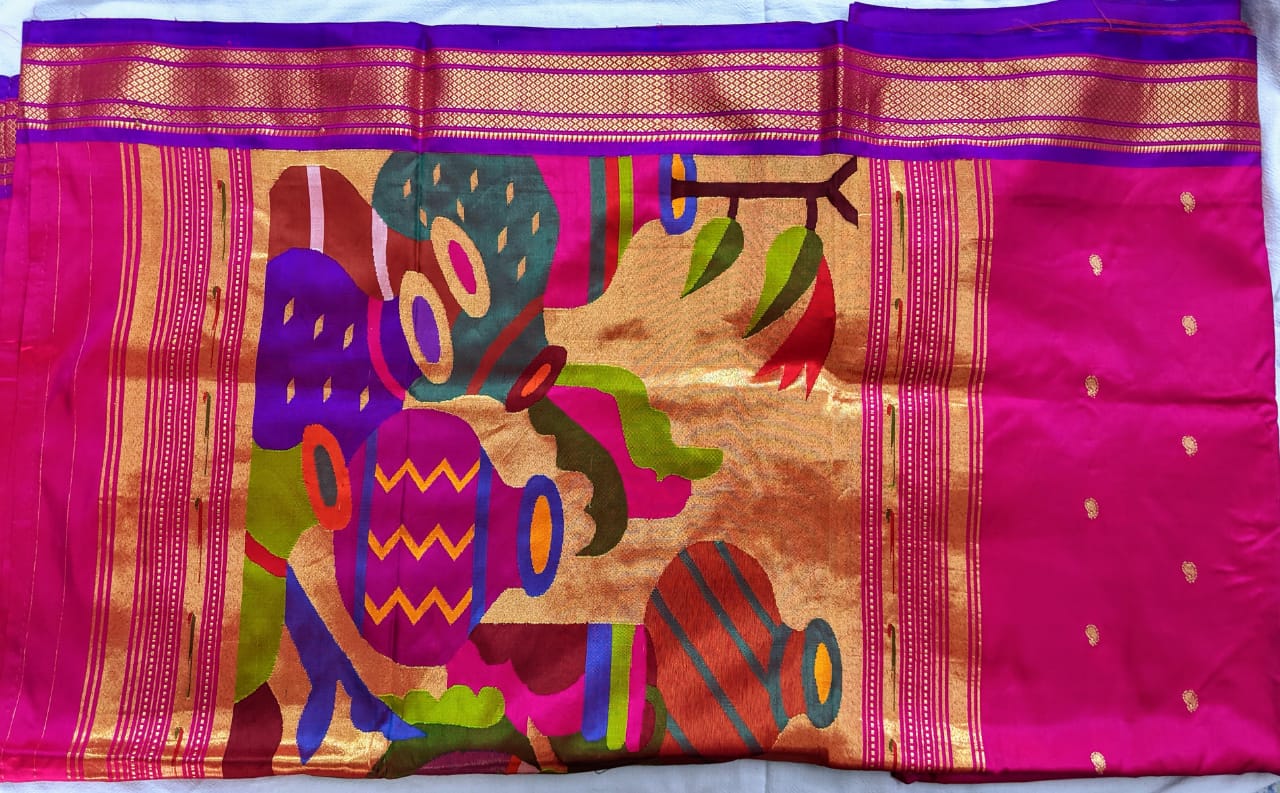
An unusual Paithani with Bal Krishna's Matkas
We are actually spoilt for choice with the Queen of sarees, the Kanjivaram silk, Banarasi brocade and Paithani.
A traditional Kanjivaram
What about the Manipuri silk, Kerala Kasavu Saree, Mysore silk, Tanchoi Tussar, Himroo, Gicha, Munga, Mulberry silk, Chanderi, Maheshwari, Baluchari, Matka, Bomkai, Sambalpuri, Ilkal ,Narayanpet, Gadwal, Venkatgiri, Mangalgiri, Uppada and Jamdani - My list can go on and on. 

The Kalamkari work is done by a pen dipped in dyes and hand drawn on the fabric. History dates it back to the 13
th century when songsters with a cultural bent of mind went from one area to the other practicing this art which got patronage from the Golkonda kings.
Madhubani Silk
Madhubanis belong to the same category as Kalamkaris, done by twigs, matchsticks etc. Warli designs are done by a fine brush. Ajrak is also block printing but the print is also on the reverse side. It dates back to anywhere between 2000-3000 years and is mainly done on cotton and silk. The Bagh prints are manufactured  in the village Bagh on the banks of the Bagh River in MP. It dates back to the times of Alexander. The Himroo woven near Aurangabad is almost 500 years old. Even today, it continues with Persian designs. It is believed to have had the patronage of Mohammad bin Tughlaq. The Bagru print came into prominence about 500 years ago. It is done in a small town called Bagru near Jaipur. Dabu printing came into India during ancient times when the Chinese visited India for trade. It is practiced in Rajasthan and so is the Sanganeri print.
Bagru print

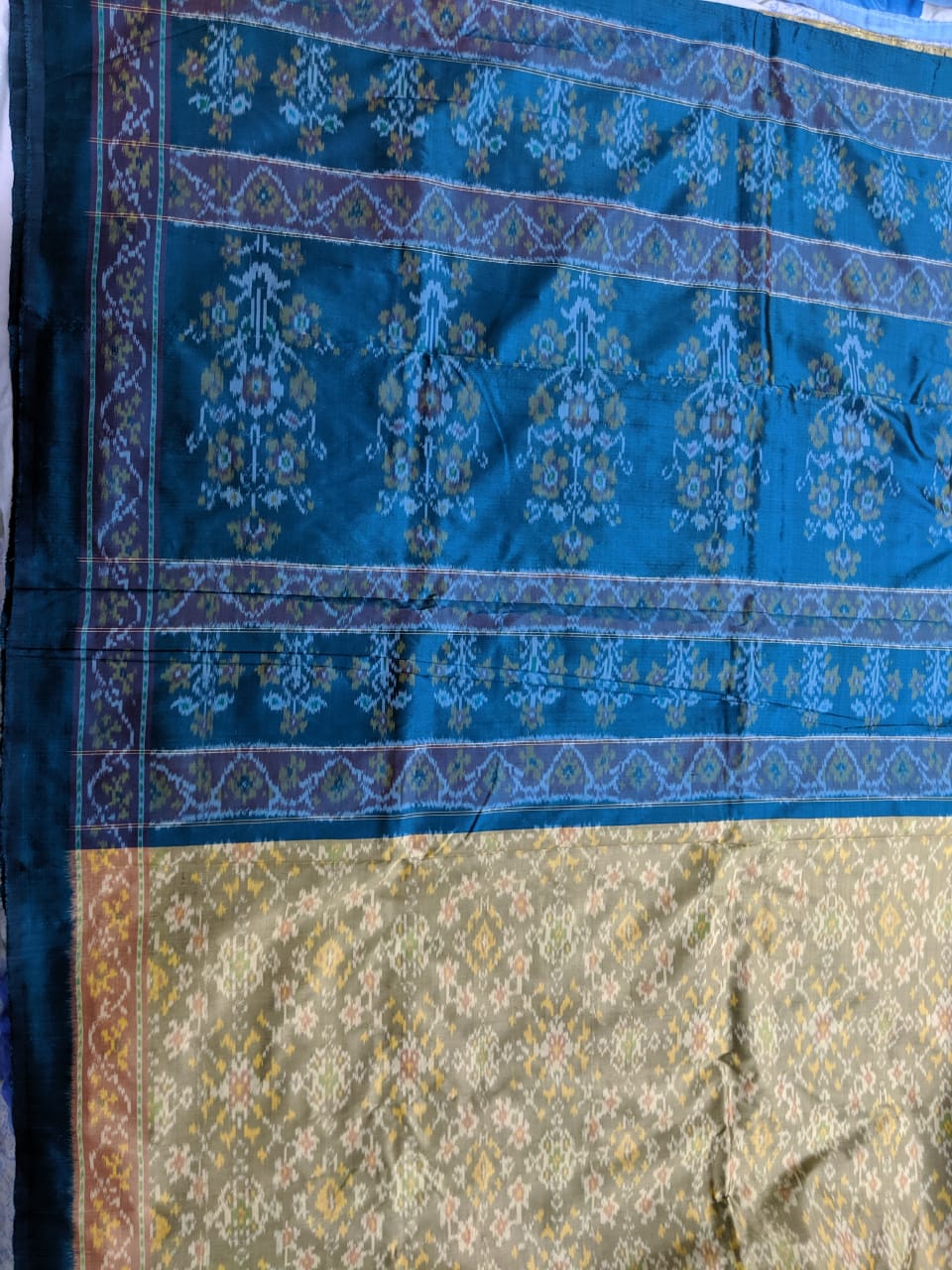
The Ikkat is very commonly seen these days and are found on Pochampallys, Patolas, Sambalpuris etc. The Tie and Dyes are done in Gujarat and Rajasthan. The fabric is tied with strings and dyed in different colours. When the strings are removed, and the fabric is dried, the design emerges.Some good examples are the Bandhani, Lahariya and Shibori which dates back to the 8th century. Batik work is done from wax and the best of them come from Chennai, West Bengal and other states as well.
Gharchola Saree

I have to thank my parents for my beautiful trousseau which is beyond reach anymore and my husband’s Army tenures which has taken me to far flung areas like Kashmir and Manipur, where I have learnt so much about handlooms. 
Manipuri Silk Saree
The travels have exposed me to an awesome learning experience and have also made me add to my collection. When I got to know that my ‘Lakshmi’ would soon join us, I started collecting sarees from various states for her and thus the saga still continues!
Bomkai

Pochampally
Chanderi silk
These elegant and sophisticated weaves are a must for every Indian woman who loves to look glamorous in an alluring traditional Saree or Kurta . They make fabulous hand-me-downs too. So the next time you are out trousseau shopping or gifting yourself a saree, don’t forget the spectacular Indian handlooms. You will be the pivot of attraction of any get-together adorning this dexterously woven, venerable and time honored drape . 
Venkatagiri
* All sarees shown are from my personal collection

Thursday, 25 July 2019

The Last Cigar

My insatiable zeal for traveling berthed us this time in the vibrant state of Gujarat. We traveled the length and breadth on wheels and were mesmerized by what this land had to offer. We brought back with us a wealth of knowledge and a lot of winsome memories.

We landed in the quaint city of Diu, one wintry morning. Though the sun was sharp during the day, a cold breeze seemed to beckon us as if to tell a story of not so bygone an era.
We were drawn to the Memorial of a 'made to scale' memorial of a Frigate, encased in a glass case.


The prudently sited Memorial on a raised piece of land overlooks an unending expanse of the Arabian Sea. The tranquil aquamarine waters coupled with the blue sky above seemed to have a lot to enunciate. I decided to shut down, pick up my ears and scour out of the depository; a chunk of history that lay approximately 40 nautical miles off the coast of Diu.


This is the soul-stirring saga of the dauntless grit of a hero - Capt Mahendranath Mulla, MVC.

He was commanding INS Khukri, a blackwood class Frigate during the 1971 war. Diu was the assembly area for ships in readiness to attack the Karachi harbor. INS Kirpan and INS Khukri were berthed in the placid waters awaiting orders.
It was another routine evening with the sinking sun casting gorgeous hues of orange and yellow on the vast canvas of the sky. Work was as usual when the communique of the sinking of 'PNS Ghazi', a Pakistani submarine by the Indian Navy arrived. This was received with much gusto and jubilation. Very soon the crew gathered together to raise a toast to the sinking of the Ghazi.

It was a pitch dark night with the moon obscured by clouds. There was almost no visibility through the periscope. The crew was busy testing the improved version of the sonar on the ship. PNS Hangor, a Daphne class submarine had already left Karachi harbor in all readiness for an attack.INS Khukri was unaware of Hangor lurking stealthily underwater.
PNS Hangor fired their first torpedo at INS Kirpan which failed to explode. Unfortunately, INS Kirpan turned away from its location. Getting its act together, INS Khukri darted towards Hangor. A torpedo was fired at Khukri which unluckily exploded under the oil tanks and the boiler room.

During the pandemonium and chaos, fully aware that the Frigate was sinking, Capt Mulla was personally supervising the rescue of his men. Most officers were caught below the deck. The Capt along with others were pushing the officers trapped, through a small hatch door. Most of them got thrown into the icy-cold waters of the sea. They were insisting on the Capt to abandon the ship. But Capt Mulla was adamant and stayed on. According to Capt Manu Sharma, a survivor, the last words he heard from his Capt were "You go and don't worry about me." After going underwater and coming up, he could see from a far distance, Capt Mulla holding the top of the ship's railing and smoking a cigar. The ship was steadily sinking and he was seen going down with it true to the highest traditions of the Indian Navy.

What attributes go into the making of such brave men? Is it fearlessness coupled with unflinching patriotism, intrepidity, and the pluck to do the impossible? In the words of Mrs Ameeta Mulla Wattal, she says "Never call your best action a sacrifice. If one fights for a cause, it is because one cannot live with the way things are."

Those who knew Capt Mulla describe him as an officer who was extremely courageous, determined with a prodigious devotion to duty. At the same time, he was light-hearted with an exceptional penchant for Urdu poetry. he was a great inspiration to his men and had a way to keep them motivated. One survivor wrote, " he not only taught us to live but also how to die."

INS Khukri took along with her Capt Mahendranath Mula, Cdr Muktadavil Oommen, 16 brave officers and 176 sailors. She was the first ship to sink after the Second World War.

As a gust of strong wind swept through my tangled hair, a chill ran down my spine, I held on to my shawl, hugging it a little closer and read the name etched on the edifice, right to the last man. What a stupendous sacrifice. What dynamic people, who will forever embody the lofty ethics of the Indian Navy.

References:
- Tehelka _ khukri
- Transition to triumph by Vice Admiral GM Hiranandani
- INS Khukri survivor stories
- Why they chose to go down - Ameeta Mulla Wattal


Tuesday, 29 March 2016

The Migratory Birds

Many of us moms feel that the smaller your child, the bigger the problem. But actually it is not so. The problems are there at every stage but differently poised. You are most often at the receiving end and the Shakuntala Devi to solve them all ,the best way you can. My son is 33 now .Born to me when I was 21 years old. He has been an excellent student and all rounder. Is a senior product manager with a US firm. We came to settle in Bangalore because of the children. People used to ask me how in this age two generations can live together so amicably ? In fact a lady doing a research on modern day joint families had a questionnaire for me too. First week of last month we got a jolt when he told us that he has been given an intra company transfer and promotion with a great package to California. Decision was theirs and they decided to go for the exposure etc, etc . I also told them to move on. But inside I could not accept it at all. I feel so down and out and cannot imagine a house without the lovely holidays, weekends, movies, discovering new eateries and above all the noise and the din. My husband brainwashes me every day. But not very effective. Now it is counting hours and the day after , my two most beautiful birds will migrate . I will wait for the next season impatiently when the same birds will fly back here for that short spell of migration. Friends console by saying , these days there is skype, they are just a call away and give me all the moral support. Yet a MOM will still remain a MOM. The touch and feel and din of your children can never be replaced. Instead of leaving you on a sordid note, I must tell you of the phrase my husband coined today ! He said " When he was born, he cried. Now when he flies to make a nest of his own, you cry " !

Thursday, 17 March 2016

The 'Special' Train

Even during a long sojourn in the Army, we ladies have to be exceptionally lucky to embark on a journey on an 'Army Special'. When I got this unique opportunity in 1985, not a single lady in our Cantt seemed to have ventured into this unchartered territory. Hence they had nothing to contribute towards this subject. It was just another general question "When is the paltan moving? Are you families also travelling by the train? " Some soggy squid squelched "It is better you ladies go home first and join your husbands later. It would be too tough for you" To me, it was a pot of befuddlement which was on a constant boil! It was only my better half and the other officers and ladies of our Paltan who put my fears asunder and were emphatic that I must chug along on this  'Choo-Choo train' with my three year old son; a chance I may never get again.
My husband had not taken annual leave for a long time because of this impending move.The CO unexpectedly sanctioned leave and we left for home after packing our abstemious belongings in a jiffy with the help of Man Friday (the Sahayak) . After a 20 day break, we were journeying back to the paltan. The route was long with two trains to change - one at Allahabad and one at Cooch Behar. When we reached Jalpaiguri Station around 0700 hrs and I was still in my slumber, we suddenly saw our Batallion Jawans, at least 6 of them rush into our compartment. There was a quick exchange of words with the Major and soon I saw my child being carried out, bedsheets crumpled and taken out , followed by the luggage and me following in a flurry. With bewilderment, I was closely watching the proceedings. My husband then told me that the 'Special Train' was berthed here and was being loaded ahead of schedule, hence this disembarkation .
We were taken to the Army area, where each family was allotted a room. A rousing welcome awaited me. A senior Comapny Commander's wife, who was put up in the next room had already catered for boiled water and milk for my son. She went few miles further to keep two comforters for us, since she knew that ours would have been already packed.Those were the days of Company commanders of 16-18 years of seniority, with 11 bachelors to chew our brains out!
The ladies were given standing notice that once the loading was complete, we had to be ready to leave in two hours time approximately, and thereafter be the 'mehmaan' of the Indian Railways, till we reach the new destination. It was just not the Fauji, but his wife too, who is disciplined, to be in a state of readiness always and every time .Two to three days went by. Due to the proximity of the rooms, I would suddenly hear "Aaj jaana hai kya ? " A quick retort - "Batadenge". The men were never to be seen. It was a woman's world. No cooking , no washing - just eating off the mess with an odd whinge " Aaj khaana theek nahi bana Bhaiya! " "Samuel ( the chef extraordinaire) nahi hai kya?"
The ladies decided to surprise the officers at the Railway Station next evening, where the train was bunked. We wanted to have a first look-see of our ' Palace on Wheels ' .A surprise awaited us. After a hard day's toil, the officers were happily perched on chairs, with their fatigues still on ,right in the middle of the railway platform. Being a Gorkha Paltan, lot of yummy snacks and liquid assets were flowing by. We spent the rest of the evening with them and returned to our nests when the children started sniveling. That was our first group outing at Jalpaiguri. Next day, early morning, one of the senior most Company Commander's wives decided to approach the CO to request him for his 'blessings' to send us shopping. Those days, CO's were treated like Demi Gods. Not a whimper in his presence. He would walk around with a stiff upper lip ,most of the time with a suspicious look. To make things a little worse, the Gorkha Hat in our Regiment is worn with the strap coming upto the lower lip. The meaning was loud and clear - 'should be seen but not heard'!
We could not sleep that night . Cups and saucers, dragon soup bowls and the Pink Lady dinner sets were playing merry hell .We collected all the notes, change what ever else jingled in our bags . Coerced our husbands to donate wholeheartedly, which they did with a heavy heart. We got into two cycle rickshaws and were off on this obscure trip sitting one on top of another to the Siliguri Market. We just about spared the rickshaw puller, by not sitting on the handle bar! Unfortunately our lucky planets were not in the right conjunction that day - Rahu and Ketu seemed to have emerged from nowhere. There was a shopkeeper's Bandh! But no doubting the Army man and his wife's tenacity .No Shani, no Rahu , no Ketu !
We found a shopkeeper sitting outside his shop with the shutters downed ,sipping a cup of chai. We forced him hammer and tongs to take us to his dingy godown. That turned out to be a hattrick! The grubby backstreets led us to a piled up, dimly lit stockpile - a potpourri of all kinds of articles, which seemed to be waiting to fall on our heads anytime. Finally we collected our ware in a scurry and hurried back this  time with an extra cycle rickshaw ! A sight to behold -  Tea sets, Crystal ,Soup bowls,  slippers etc stacked on everybody's laps. It seemed we were in a rickshaw with an invisible puller! When we reached, the CO was standing right in the middle of the road, with his arms on his hips giving one of those contemptuous looks. He almost snarled that we are too late and he made the gravest mistake to send us on this spree! No time to pack our ware and show it off to our husbands .They were already giving dirty looks and nudging us. Some were hisssing like reptiles into their wives' ears. All said and done, our ' Operation Shopaholic' was a super success. No casualties reported except for the COs high blood pressure -  a win - win situation!
We were hurried to the railway platform and jostled into our bogies. There were 3 coupes in our compartment. One extremely private and special for the CO and his family with those two scary alphabets CO stuck on the door. But the dispirited moment came when we were told that we were in the next coupe, with an 'OC Train' tag on our door. All the fun and frolic we had planned came shattering on our faces, with strict instructions from the husbands that noise pollution was a strict NO, NO  in a VIP compartment. Also applicable to our ' bacchas ' !
I did not know what this 'OC Train ' was all about. Soon, our friends explained that it was an honor bestowed on my husband! ! At that inexperienced age, every occurrence was either euphoric or a revelation. The train finally left and slowly it unfolded to me that this supposedly honorous task was going to be our headache for the next 10 days!  The JCO from the engine room seemed to have become my husband's soulmate from a previous  ' Janam'. His queries were never ending. the husband's phone would ring incessantly. An hour before the next halt, the OC was intimated about the impending stop and I would see my husband jump into his uniform. My mind's eye started working overtime - Was this the Gemini Circus? Or was it that my husband had taken over as the  guard temporarily ? I could almost see him flagging the train off !
The first halt next morning was for breakfast. We were told that the train would halt for three hours. Three hours at one station? Never ever heard of it! Every day was a new beginning with a box of surprises. The train would halt on secluded platforms, the buglers would come out and start playing their bugles and at the same time the riflemen would jump out to cordon our train. We walked on the platform  and saw feverish activity in the pantry car. Soon the Mess Havaldar in his regalia announced to the PMC "Bhojan taiyyar cha Srimaan! " We would make a disciplined single file, not according to height as in school, but according to our husband's seniority! Food on the train was not in the least gourmet, with Philadelphia cheesecake but was tasty and fresh. The exhaustion of the journey poured in more digestive juices into our stomachs for a sumptuous meal.  It seemed to be like the 'Recipes from the Royal Kitchen'! 
The other couple in our coupe was the just married variety. Wonder who thought of this combo? A starry eyed couple and us, with this OC getting up at all unearthly hours passing messages or receiving them. To add to it, our bachha had to be accompanied for his nature's calls, with his little unhappy whimpers. I had advised the couple that this was not the ideal honeymoon suite. But destiny seemed to prevail on them. Now we became their permanent 'kabab mein haddi' . 
One hilarious incident I must narrate - Once during the wee hours of the morning, the train stopped suddenly , with a jerk - an unscheduled stop. My dear husband after downing 'few' was fast asleep, dreaming in Army land. After a little while, from the upper berth, the newly wed officer called out " Sir, Gaadi ruk gayi hai! " By then we saw a familiar face at the window - one of our most humourous officers. He was knocking feverishly at the window saying " Gaadi kabka bandh ho gaya. Hum pohonch gaye kya ?" The CO with his cane was hitting the wall of our coupe from his side. I was so scared that my son would wake and join this melee. Altogether sheer pandemonium. Finally the OC got up to find out what went wrong and to sort it out. Even today, when we all get to gether, we have a hearty laugh on this !
I was overwhelmed to see the length of the train pulled by two engines. The unique compartments - Yorkshire pigs in one, the stray dogs who had become the property of each company - Jhumki, Hitler et all in the other. We had our families, the shaktimaans, jeeps and jongaas, the LMGs, mortars, the quarterguard in tow. These days we speak of 'Haute Couture' . Our officers then suddenly seemed to become very fashionable, wearing shorts and T shirts. Denim jeans were not even heard of in the uniformed forces those days. This was high fashion for us. Many of them could not even be recognized!  Every evening , an ' all OK report' had to be given to my husband who would then transmit it to the CO. Suddenly one evening, it was reported that one 'Sungur' ( pig ) had run away. There was no question of continuing our expedition ! There was a dragnet thrown to catch the 'runaway'. More time at the same place and a little more chaos. Finally, a panting Jawan ran to say that 'the piggy on the railway was picking up stones' and securely brought back to the fold !
The usage of bath facilities was also as per seniority. If the CO was in and there was an emergency (which thankfully there wasnt), maybe we would have had to hang on to the Chain! Hot water would be brought for each saab by the sahayak and a 'safaiwaala' would clean the bathroom after each visit. I suppose this was the privileged comparment. The soiled clothes were sent to the dhobi. At the next stop, it would be washed and hung in bright sunshine. By evening, the ironed clothes would be back. So in case you travel, do get a new wardrobe for yourself to show off your clothes which will distinctly stand out !
The long breaks would see a total transformation of an ordinary railway platform. Dining tables set up with damask sheets, Bridge tables set up, nets put up for throwball, ladies and officers bursting into Antakshari, it was indeed an excursion of 10 days - A saga of unforgettable lifetime memories. Beautiful sun rises would give way to brilliant sunsets. The frangrance of fresh breeze, wet earth and the hint of the warm winter sun were mesmeric. Scenes changed like a kaleidoscope. The most masaaledaar stories would make the rounds from one bogie to another. I had carried along a few books to read, but did not even open them. I was going through one of the most ecstatic phases of my life. Here is where I saw the true zest for life. The Army fought hard, worked hard and played hard. A lesson for everybody. It was a luxe life with sweet indulgences.
Finally we reached our destination. We were told to be ready semi formally, three hours prior itself, to meet the Battalion  who was coming to receive us at the station. The band played the welcome tune, bouquets were exchanged, and we strutted off, feeling a bit disoriented and light headed. It was the beginning of yet another tenure, a new life, in a different part of our country. Now if anybody asks me if I have ever travelled on the Palace on Wheels, my answer is an emphatic YES!. Our trip was nothing short of it. If you ever get a chance, dont miss it for dear life!
"The adventures that seem the most difficult and scariest
 are usually the ones that you will look back on, 
 smile and remember forever"
                                                - Craig Guillote
Written by Mrs Sarah Koshy Johnson
GLOSSARY OF TERMS
CO - Commanding Officer
OC Train - Officer Commanding Train
Mehemaan - Guest
Aaj jaana hai kya - Do we leave today
Bata denge - Will inform
Officers Mess - Where the Officers dine
Aaj khana theek nahi bana bhaiya - The food is not very well made today
Cook Samuel nahi hai kya ? - Isnt the cook Samuel there?
Paltan - Hindi word for batallion
Bandh - A strike
Chaai - tea
Janam - Birth
PMC - President Mess Committee
Bhojan taiyaar cha Srimaan - Food is ready, sir
Kabab mein haddi - instrusive element
saab - sir
Sungur - pig, in Nepali
masaledaar - spiced up
Gaadi ruk gayi hai - The train has stopped
Hum pohonch gaye kya - have we reached already?
 

Monday, 21 September 2015

An Open letter to Mr Chetan Bhagat as a reply to his article on OROP

Article dated 20 Sept 2015 in the Times of India.
For your reference http://blogs.timesofindia.indiatimes.com/The-underage-optimist/its-time-to-analyze-orop-with-our-head-not-our-heart/


Dear Mr Chetan Bhagat,
Before I shoot straight from the hip let me elicit few accolades which you certainly deserve. I love the way you write and the manner in which you involve us with the characters in the book. I have read a few books authored by you like 'Five point someone' and 'Two states' . Two States was fantastic. You seem to have researched the two communities brilliantly. Currently I am reading your book 'Making India awesome'.

I was amazed and shocked at the article you wrote in the Times of India of 19 Sep 2015 on OROP. A person of your caliber I feel should not have written such a distasteful, ill researched piece. Being one of my favorite authors I suddenly realized that you too have clay feet. Let me take you on point by point -
  1. You say that 'with the Army's selfless sacrifice, the Army enjoys a lot of support from the civilians' . You are wrong Mr Bhagat. An average Indian civilian citizen has scant knowledge of the Forces unless that particular generation had witnessed a war. Compare our forces with that of the US and UK. Don’t you feel that their civilians feel much more for their  forces and are extremely well  informed? Three or  four patriotic Hindi films do not make a difference to our population.
  1. OROP a misnomer according to you. Why do you think the IAS, IFS get the OROP without a fast unto death at the Jantar Mantar. Why is their 'Over the table' component so different from ours. Let me not elaborate about their 'under the table' dealings since it would be quite a mean thing for me to do. Why did the previous pay commissions not have a single member from the armed forces. Is this justified.
  2. You speak about the 12 Crores to veterans as OROP. Do you know that out of the 60000 Crore Defence budget, 45% of it goes to the civilians. And what about the crores written off by successive governments to pursue their political agenda. We have an example glaring into our faces right now. Bihar has been given 1,21,000 crores, just before their elections. The deed is indeed very large hearted but the timing is questionable. The Telengana chief minister's maharaja kind of visit in crores, the 'Pravasa Yatra' from Karnataka with families to foreign lands at the cost of our ex-checker to learn how to milk cows, as one foolish 'leader' nonchalantly said on media, indeed is thought provoking. The subsidized Biryanis and Mutton Roghan Josh at the Parliament's canteen is also praise worthy!
  3. 'To pay veterans more or new hires more': My take on this is that the veterans too have given the prime of their lives in those ancient days with the same challenges with hardly any facilities for a paltry sum of money. That generation of veterans had also fought wars. One  in 1947-1948 against the marauders, 1962 the Chinese debacle, 1965 the Pakistan War, 1971 - Independence of Bangladesh and 1998 the Kargil War. The pension the earlier veterans are drawing is so miniscule and cannot be even termed as a payback for the services rendered. Do not forget our PoW's, still languishing in prisons unknown, across our borders. What is the state of their families, have you given a thought to this?
  1. 'Soldiers retired safe and sound' -Does not mean that at some point or the other these soldiers have not faced life threatening situations and many a narrow miss. It is not you and me, but God's benevolent grace that has brought them back home. I am sure you believe in the life line, don’t you.
  1. There is no emotion behind asking for OROP -  It has been the soldier's right since 1973 when pensions of Armed Forces were brought down from 70% to 50%, while the civilian pensions were increased. Thereafter successive pay commissions diluted what was left including our stature in the hierarchy. You will be surprised to know that one of our veterans Maj Dhanapalan had to go to the Kerala High Court for the correct interpretation of the 'Rank Pay'. Despite the verdict in favour of the soldier, the babus made sure that the entire amount was not paid. There are cases in this regard being fought in the Supreme Court even today.
  2. 'Politicians Bad and Army Good' - You seem to have used a broad brush technique here. No one will ever say that all politicians are bad and all soldiers good.
  3. You don’t have to do much now to disrespect soldiers, you have already done the needful. The rest of it has been taken care by gagging the press. Free press is a democratic right. Your peer, Mr Arnab Goswami, another alumni of the IIM , who I thought was bold and upfront seems to be muffled too. He fights vehemently for every other issue under the sun and the least  for the OROP. I am confused, Mr Bhagat, are we still in a democratic nation or a dictatorial one?
  4. You have missed the crux. This is not an agitation to increase pensions. It is to give our veterans their dues, which have been wrongly denied to them by successive governments. Your questions are no more amusing. It challenges your basic intellect. You also seem to be trying to cut wedges amongst the Armed Forces with your do's and do not's. But you did not know that we are more grounded, disciplined and can walk shoulder to shoulder  with our comrades.
  1. Your motive in writing this article seems suspect or you have fuddled somewhere. Being the son of an Army officer, please ask your dad whether he agrees with what you say. Thank you for speaking against us. A noteworthy writer like you is being used as a pawn in the game to spread misinformation. You could enjoy a blooming romance in the IIM  because there were soldiers without their families standing guard watching over us, as we ate, slept, played, studied and worked. If not for that soldier, leave alone romance, considering our invaders, even looking at a lady would have become a crime. You may take Afghanistan as a good example for this. Don’t get me wrong on this please. I too love romantic novels and movies. This subject has been already analyzed by the heart. While I agree with you that we need to think with our brains, may I also add that the cobwebs that have gathered on it  have to be cleared to allow rational and justified thinking. Let the heart fall in love while the brain starts to work. 


Written by an Army Veteran's Wife.

Mrs Sarah Koshy Johnson